
Torque Wrench Calibration
How often to calibrate, what a home hanging-weight check can prove, and when you need an accredited lab.
By Owen Briggs ·
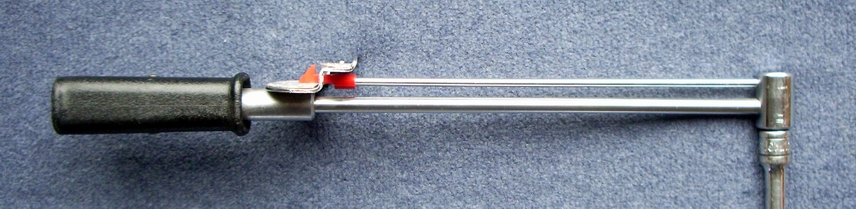
Torque wrench calibration is how you find out whether the click still means the number on the scale. Springs fatigue. Digital gauges drift. Drops move things. ISO 6789 is the language labs use for hand torque tools. Your driveway is not a lab. It can still tell you if the wrench is a liar.
You can check a wrench at home with a vise, a known weight, and a tape measure. That answers “is this thing wildly wrong?” A calibration lab answers “can I document the error?” with ISO/IEC 17025 and a certificate. Both are useful. They are not the same job.
When to check, when to certify
| Use | Check at home | Send to a lab |
|---|---|---|
| Occasional DIY wheels | Once a year or after a drop | Usually not worth it; replace cheap wrenches |
| Weekend engine work | Before a head or rod job | If the wrench is expensive and you want a paper trail |
| Daily shop use | After any overload | Every 6–12 months or 5,000 cycles |
| After a 25% overload | Do not use it | Required thinking; many makers say recalibrate |
A home hanging-weight check
The physics is torque equals force times distance. Secure the square drive so the handle can swing in a horizontal plane. Measure from the center of the drive to the point on the handle where the weight will hang — that is the effective length. A known mass on a string, hanging at 90 degrees, applies weight × length.
Example: a 20 lb weight hanging 2 feet from the drive center is 40 ft-lb. Set a click wrench to 40 ft-lb. If it clicks before the weight is fully supported, the wrench is reading high. If it will not click with the weight hanging, it is reading low. Stay within a few percent for a consumer clicker; ±4% is a common mechanical claim.
A luggage scale pulled at 90 degrees can replace hanging weights if you are careful about the angle. Any side load wrecks the math. This is the method in those five-minute videos. It is a check, not a calibration certificate.
What a calibration lab does
An accredited lab uses a traceable transducer, controlled loading, and a written uncertainty. ISO 6789-2 describes how that calibration is performed for hand torque tools. You get a report: error at several points, clockwise and maybe counterclockwise, sometimes a sticker. Snap-on, Norbar, SIMCO, and regional labs all sell this service.
Cheap wrenches often cost less than the cal. That is not a scandal. Replace Pittsburgh, keep ICON, certify Snap-on. That is the Harbor Freight versus Snap-on split.
Storage is half of calibration
A click wrench left at 150 ft-lb is being calibrated by time into the wrong direction. Wind it to the lowest marked setting. Do not use it as a breaker bar. Do not drop it and keep working. Digital wrenches need batteries that are not half-dead during a “check.” The how-to is the daily habit. Checking the wrench is the audit.
If you are choosing a first wrench, start with the buying order, then come back when the tool has a year of driveway miles on it.
Common questions
You can check it. Hang a known weight at a measured distance from the square drive and compare the click or reading to weight times length. That catches a wrench that is badly off. It is not the same as an ISO 6789 laboratory calibration with a certificate.