
How to Use a Torque Wrench
Set the scale, pull steadily, stop at the click, and store the wrench so the spring stays honest.
By Owen Briggs ·
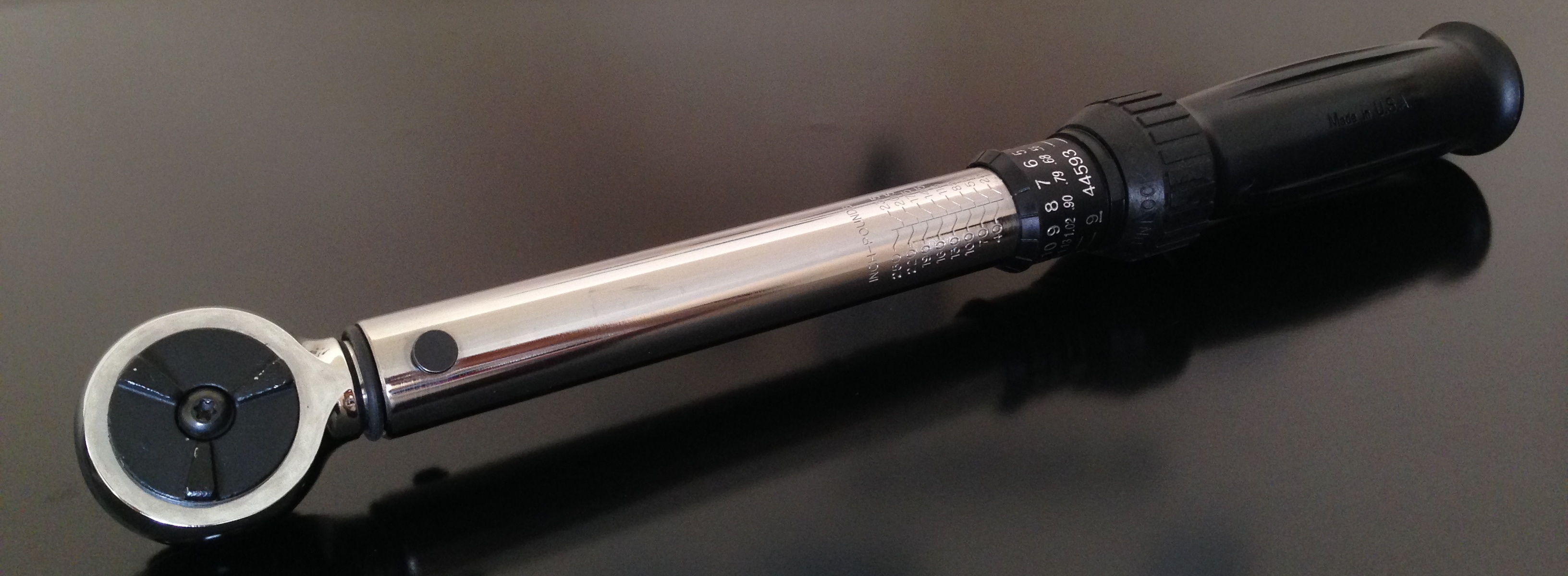
Using a torque wrench is a short ritual: pick the right drive, convert the spec if needed, set the scale, lock it, pull straight, and stop at the first signal. The tool is not a stronger ratchet. It is a gauge that happens to turn a bolt.
Most damaged fasteners in a home garage come from two mistakes. People guess instead of setting a number. Or they set the number and then keep pulling after the click “to be sure.” Both mistakes are avoidable.
1. Match the wrench to the spec
Read the spec in the service manual, not a forum guess. Wheel nuts are usually foot-pounds. Spark plugs, valve covers, and many sensor bolts are inch-pounds. A 1/2-inch wrench set to 12 ft-lb is a poor way to apply 144 in-lb; the scale is coarse and you are working at the bottom of its accuracy window.
If the spec is in newton-meters, convert it once and write the foot-pound number on a piece of tape. The converter does the arithmetic. Do not mix units mid-job.
| Spec you see | Wrench to reach for | Typical drive |
|---|---|---|
| 80–140 ft-lb lug nuts | 1/2 in click, 25–250 ft-lb | 1/2 in |
| 18–80 ft-lb chassis and brakes | 3/8 in click, 10–100 ft-lb | 3/8 in |
| 80–180 in-lb plugs and covers | 1/4 in inch-pound click or beam | 1/4 in |
| Torque plus angle | Digital wrench with angle mode | 3/8 or 1/2 in |
2. Set a click wrench correctly
Unlock the handle. Turn the micrometer scale until the major mark and the fine scale add up to the spec. On a wrench marked in 10 ft-lb increments with a 1 ft-lb micrometer ring, 95 ft-lb means the handle sits on 90 and the ring adds 5. Lock the collar so the setting cannot creep while you pull.
If you overshoot the number, go down past it and come back up. The spring remembers the last direction you turned. Coming up from below is how you repeat the same setting.
3. Pull, do not jerk
Put the socket fully on the fastener. Hold the wrench at the marked grip, not halfway up the shaft. Pull at 90 degrees to the handle. A side load from a cheater pipe or a cocked socket is not the torque you set.
Increase force smoothly. The click is a mechanical release. You will hear it and feel it in the handle. Stop there. On a digital wrench, stop at the beep, vibration, or green light — the one the manual describes as “target reached,” not the over-torque alarm.
Extensions change leverage. A long extension or a crow’s foot on the head can add or subtract from the reading depending on geometry. If the adapter sits in line with the drive, the effect is small. If it sits to the side, do the crow’s-foot math or use a longer wrench instead.
4. Tighten in a pattern
Wheels, manifolds, and heads are not one-bolt jobs. Snug in a star or spiral until the parts seat, then torque in stages. For lug nuts, that usually means snug with the wheel off the ground, lower the car, then final torque in a star. Jumping straight to 140 ft-lb on a hanging wheel can leave the rotor or drum not seated.
Stage torque exists for a reason. A head gasket does not clamp evenly if bolt one is at spec while bolt ten is still finger-tight.
5. Reset and store
When the job is done, unlock the handle and wind a click wrench down to its lowest marked value. That is not “zero.” Going below the printed minimum can unseat the spring. Put the wrench in its case, not loose under a jack.
Beam wrenches do not need this ritual. They also ask you to watch a needle while you pull, which is why they are honest and why they are slower. Digital wrenches need the batteries out if they will sit for months, and they still need periodic calibration.
Mistakes that ruin a good wrench
- Using it as a breaker bar on rusty nuts.
- Dropping it on concrete and pretending nothing happened.
- Leaving it set at highway-wheel torque for six months.
- Pulling with a pipe over the handle.
- Clicking twice “for luck.”
If you only remember one rule: the click is the measurement. Everything after the click is extra clamp you did not ask for. For shopping context, the buying list explains which drive size belongs in which drawer.
Common questions
Eighteen foot-pounds is a light pull on a 3/8-inch wrench and almost nothing on a long 1/2-inch handle. You cannot judge it by “feel.” Set the wrench and stop at the click. Hand-tight plus a grunt is how plastic intake bolts get stripped.